

Folks often remind me of how fortunate I was to have grown up during the carefree 1950’s and 60’s, and while I certainly don’t disagree, it might not have been quite as idyllic as some might suggest.
The 1950’s began with one of the largest, fear mongering, conspiracy theories ever perpetrated on the American public, the false claim that the Soviet Union had infiltrated the United States government with dozens, if not hundreds, of communist subversives. On a Lincoln Day speech on February 9, 1950, Wisconsin Senator Joseph McCarthy produced a list of 205 State Department employees that he insisted were know communists.
The Iron Curtain had formed after WWII with the growth of the Soviet Union and the rise to power of communist regimes in much of eastern Europe. That, along with the communist take over of China in 1949 and the threat of the same happening on the Korean peninsula made the atmosphere ripe for the theory that the United States could be next.
The Red Scare was real, and the powerful House Committee on Un-American Activities, largely fueled by McCarthy’s unsubstantiated allegations of communist influence in America, did nothing but ruin the careers of many Americans and stoke the fears of others.
At the same time, the world was dealing with the ravages of the growing polio epidemic. In the early 1950s, polio was one of the most widespread communicable diseases among children in the United States.
Nearly 60,000 children were infected with the virus in 1952; the disease left thousands paralyzed, and more than 3,000 dead in that year alone. Hospitals set up special units with multiple iron lung machines just to keep polio victims alive. It wasn’t until Jonas Salk’s polio vaccine became widespread in 1955 that the disease began to wane before it was eventually eradicated in the United States.
The proliferation of nuclear weapons during the 1950’s saw the building of bomb shelters and a program of indoctrination for children where they were taught to duck and cover under their desks at school should there be a nuclear attack. The fear was real, even if the threat was remote, and the routine with Bert the Turtle and his catchy Duck and Cover theme song absolutely stupid.

1963 saw the assassination of President Kennedy in November. In 1968, both civil rights activist Martin Luther King and presidential candidate Robert F. Kennedy were gunned down and killed. The unpopular war in Vietnam spurred protests in many cities, and the ensuing riots at the 1968 Democratic Convention in Chicago added to the political tensions of the era.
If all the above sounds at least vaguely similar to the events of the last few years, it’s because it is. History does repeat itself; at least in terms of how man deals with events, politics, and the presence of disease. Whatever we should have learned from the past seems to be quickly forgotten when a new threat comes along. Reason doesn’t always prevail over emotion.
But some things do change, and one of them is how we raise and protect our children. In the 1950’s and 60’s, growing up in America was vastly different than it is today. You can judge for yourself if our kids are better off today than they were 60 or 70 years ago, and it’s obvious that some things we do today better protect our children now versus then, but for those of us who grew up back then, we might argue that life in general was a little more fulfilling and rewarding than it might be for today’s youth.
In the 1950’s if the kids accompanied mom on a trip to the store, they simply got into the car and sat down – unless they could see better by standing up and looking out of the window. There were no seat belts of any kind prior to 1949 when Nash offered them as a factory installed option. 40,000 units were built with two-point lap belts, but buyers balked so much that Nash dealers were forced to remove them from 39,000 of those vehicles just to get the cars sold. Nash buyers were more enthralled with the vehicle’s ability to have its seats convert into rolling bedrooms than they were about arriving at their destination in one piece. The Ford Motor Company began offering lap belts as an option on their 1956 models beginning in the fall of 1955. A whopping 2% of Ford buyers opted to purchase them. Safety certainly wasn’t much of a selling point in the 1950’s.

Safety seats for infants and toddlers didn’t appear until 1968 when it was again the Ford Motor Company that offered their “collision resistant” Tot Guard child safety seats through the parts departments of their dealer network. Booster seats for young children had been around since the 1930’s, but their sole purpose had been to raise the child high enough so he or she could see out the window.
Statistics on child deaths in auto crashes have only been kept since 1976, but since that time, deaths of infants through the age of three years have dropped by two thirds, mostly due to better designed child safety seats, laws that require parents to use them, and better over-all vehicle design with more safety related features. Over-all vehicle deaths in 1950 came in at 33,186 at a death rate of 7.24 per every 100 million vehicle miles traveled. The total population that year was 152 million. By 2022, 42,795 people perished on American highways, with the death rate dropping to 1.35 per every million vehicle miles traveled; so, it’s obvious that the way we were transported as children in the 1950’s wasn’t something we would consider as beneficial to our wellbeing.
Outdoor activities were a must for every healthy child in the 1950’s and 60’s. If it wasn’t raining and there were no reports of tornadic activity within fifty miles of where you lived, kids would play outside. Snow and freezing cold didn’t deter any kid I knew. Sledding, building snow forts, snowmen, and sliding on cafeteria trays pilfered from school was every bit as much fun as riding a bike or going fishing was in the summer. Most of us resembled the Michelin Man before we left the house to tackle the elements, so no one froze to death.
Snow was also a good opportunity for kids to augment those miserly 50 cents to a dollar a week allowances our parents doled out. There weren’t a lot of snow plows in the 1950’s and almost nobody owned a snow blower. Shovels were the only way to clear driveways and pathways to the front door. Working as teams, we actually made pretty good progress and a couple of the older folks in the neighborhood not only gave us the buck or two we asked for to complete the job, they often threw in a generous tip and some warm chocolate chip cookies.
We played just about every sport imaginable … 1950’s sports that is. We had no idea what soccer was. Nor rugby, lacrosse, nor field hockey. We played baseball, football, basketball, and held our own Olympic games every four years.

In 1960, our Winter Olympic games at the Sport Hill Highlands just happened to coincide with those being held at Squaw Valley in California. The “luge” run had been groomed the day before the main event and through a stroke of good luck, the winter rain gods had provided us with a good dose of freezing rain during the night, making the course slick and very fast. My sled was the standard variety Flexible Flyer, and I made the rather unwise decision to lay on my stomach so that I could steer with my hands rather than my feet. There was a large sweeping turn through the tree lined portion of the course where I momentarily became airborne – making steering impossible! My right hand took the brunt of the impact with that medium size maple tree, breaking two of my knuckles and destroying the frame of the sled.
That was my final Winter Olympic competition.
We skated during the cold weather and played hockey when the ice was smooth enough. We used the science we learned at school to determine exactly when the ice was thick enough to skate on. After two or three days of temperatures that remained below freezing, we first sent the smallest and lightest kid out onto the ice. If it didn’t crack, we sent the next lightest kid and so on until we got to the largest. If there was still no cracking, we waited one more day and then began to skate. Only two or three times in all the years we skated did anyone get wet.
We swam wherever we could – ponds, private pools, and rivers (including the off-limits Aspetuck and Saugatuck with all those orange “No Trespassing” signs nailed to every tree and fence post on Bridgeport Hydraulic property). Pools were preferred because you seldom had to share the water with snakes.
We fished in the rivers and streams that fed the reservoirs, but only from the side of the river that wasn’t accessible from the road. A lot of us lived on property that bordered the lands of the BHC, so we had direct access and knew both the best spots to fish and the ones where we’d be least apt to be spotted. The BHC wardens never bothered us because most of them would have been on the other side of the river. We mostly avoided the reservoirs where the odds of being apprehended were exponentially higher.
We chased fire flies every evening in June and July. We camped out during the spring and summer. I don’t remember ever seeing a deer tick and no kid I ever knew came down with either Lyme Disease or Rocky Mountain spotted fever, despite the abundance of mosquitoes we would usually encounter. When they finally began launching satellites, we’d lay on the ground at night trying to spot one. One or two hours of sleep was the norm.
We rode our bicycles absolutely everywhere. There seemed to be an unwritten rule (made by us) that kids under the age of ten could ride anywhere within a mile radius of where they lived. That expanded to two or three miles between the ages of ten and thirteen, and after turning fourteen, you could peddle as far as you wanted as long as you could make it home in time for dinner. Everyone over twelve could ride any roads they wanted except for Routes 58, 59, and 136. Not that we never rode on those roads – after all, we needed to support Halzack’s, Greiser’s, and the ice cream stand at the Blue Bird; we simply used those roads as sparingly as we could. I am pretty certain that none of the more distant locations we traveled to were revealed to our parents – at least not by any of us.

Kids spending too much time in front of a television was never an issue. There was no cable TV, and no such thing as ‘streaming” or video games. Early television that wasn’t broadcast on a major network was usually only available for a few hours each day. There hadn’t been enough TV shows produced to have many re-runs in the early 1950’s. In northern Easton viewers could receive CBS (2), NBC (4), WNEW (5), ABC (7), WOR (9), and WPIX (11). The three local NY stations only broadcast for a few hours each day, and none of the stations broadcast for a full 24. Network TV signed on at 6:00 AM and ended the day at Midnight. The dreaded “test pattern” was shown when stations weren’t broadcasting regular programing. Each day’s programing ended with a still photo of the American flag while the National Anthem played.
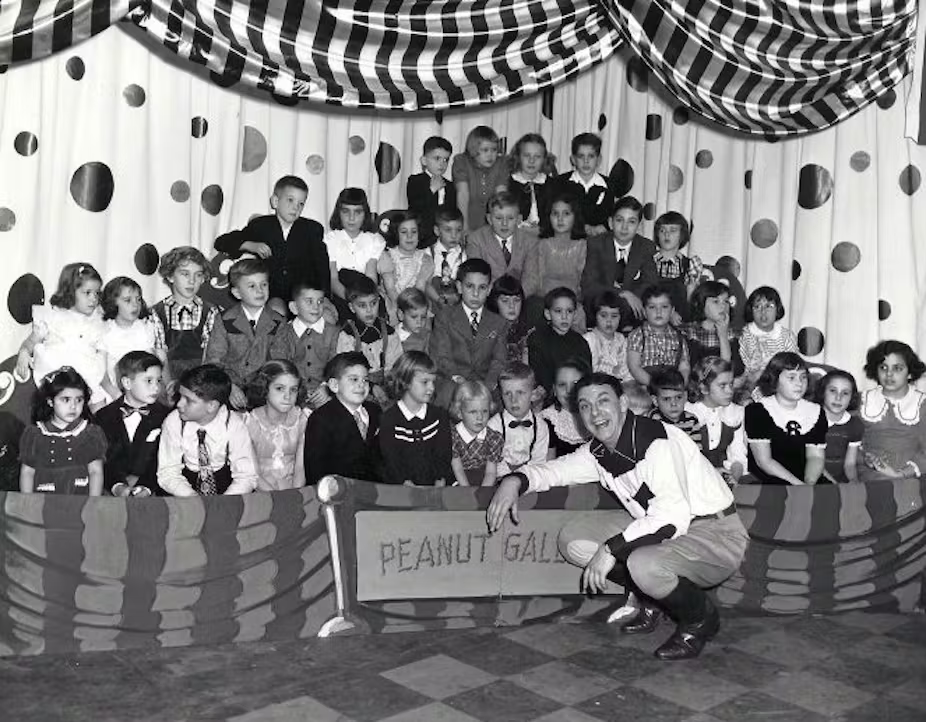
The parents of one of the kids at school knew someone in advertising who knew someone at the Howdy Doody show and that kid got to spend part of one afternoon in the Peanut Gallery. He got to meet Princess Summer-Fall-Winter-Spring and came home with an autographed Howdy Doody/Buffalo Bob lunch box. Only Bob signed it; evidently Howdy had trouble holding a pen. That boy was the most popular kid in school for at least a week.
Most families had a dog, and that dog went just about everywhere we went as kids. Perhaps that is why our parents let us roam as freely as we did, Fido was there to protect us or run home to fetch help like Lassie would if Timmy got caught in quicksand – something every kid in the 1950’s believed to be a real possibility!
If you were a male, part of the rite of passage to the teenage years was building a working go-cart. That meant requisitioning all the parts needed – including a working lawn mower engine – from one of our fathers’ garage or barn. The plan was always to build it on Monday (which usually went into Tuesday due to design and engineering issues with the steering and braking), race it around the neighborhood (on the street of course where the traction was better) on Wednesday and Thursday, and then disassemble it on Friday so the engine could be re-installed on the lawn mower so the lucky donor dad could cut the grass on Saturday.
That usually worked out pretty well, except for re-installing the engine on the lawn mower so that the machine would properly function. Somehow, we were always either short a couple of bolts or had a few left over. Either way, it almost always resulted in a less than perfect machine. You could always tell whose dad we had borrowed the lawn mower engine from by the tall grass in that family’s yard come Saturday afternoon.
Organized sports for kids existed, but they weren’t the beginning and end of the family’s existence. Most kids had just as much fun playing baseball and basketball with the other kids in the neighborhood as they did playing on a team where if you weren’t a stand out athlete, you warmed the bench. With neighborhood sports, every kid got to play because we needed the bodies. If you were lousy, you batted last and got to play right field. We never called fouls in basketball and there was no such thing as an ineligible receiver down field. Most kids eventually got better because they played in every game for the entire time.

Weekends were fun for the whole family, not some regimented schedule of never-ending kids sporting contests with each father screaming for his kid to run faster or telling him to hit the ball to right field. Saturdays were more about dad working around the yard (if his mower was functional) followed by a cookout with family and friends. Sundays were for going to church and then to the grandparents’ house for dinner with the cousins. At least a couple of times each summer, one of our dads and another neighbor or friend would take 3 or 4 of us kids to Yankee stadium where we’d get a chance to see Mickey Mantle hit a home run or Whitely Ford toss a shutout.
Yeah, I feel lucky to have grown up when I did. I also feel lucky that our parents weren’t constantly being told by the rest of society how to raise us and as a result, we weren’t smothered with an unreasonable number of rules that were explained away with, “Because I said so.” Our parents might not have hovered over us like most parents feel the need to do today, but all-in-all, I think our generation came through it pretty darn well.
